
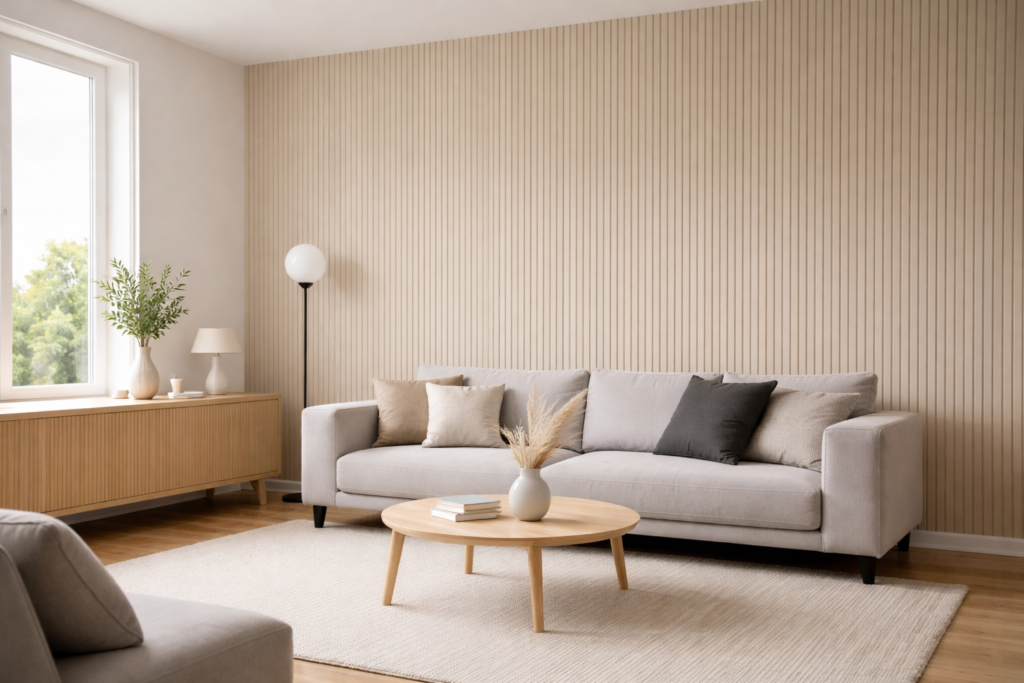
Grooved wall panels are a type of decorative wall covering defined by their clean, linear texture. Unlike flat panels or traditional wall finishes, these panels feature evenly spaced grooves carved directly into the surface. The result is a structured, geometric look that adds depth and rhythm while maintaining a minimalist and modern appearance. At their core, grooved panels are not complex—they are carefully processed boards designed to transform a plain wall into a visually dynamic surface, aligning with broader principles of architectural surface articulation commonly used in contemporary interiors and wall cladding systems.
The base of a grooved wall panel is typically a solid sheet of material. The most common option is MDF (medium-density fibreboard), which is widely used due to its smooth surface and consistency. MDF allows for precise machining, meaning the grooves can be cut evenly across the entire panel without imperfections. This creates a uniform pattern that looks clean and professional. Other materials are also used, including natural wood, plywood, and various composite boards, but MDF remains the most practical and cost-effective choice in most cases.
he defining feature of these panels is, of course, the grooves themselves. These are cut using specialized equipment that ensures accuracy in both depth and spacing. The grooves run parallel to each other, usually across the full height or width of the panel. Depending on the design, they can be subtle and narrow or wide and deep, significantly affecting the final visual impact. Shallow grooves create a soft texture that is barely noticeable from a distance, while deeper grooves generate stronger shadow lines and a more pronounced architectural expression, contributing to a refined sense of spatial hierarchy and surface modulation, and exemplifying the principles of tectonic expression through the articulation of form, repetition, and light.
Groove shapes can vary as well, and this detail plays an important role in the overall style. V-shaped grooves create sharp, crisp lines that emphasize precision and modernity. U-shaped grooves are smoother and more rounded, giving the panel a softer, more flowing appearance. Some panels use rectangular cuts or custom profiles, which can make the design feel more unique or decorative. Even small changes in groove shape can completely alter how the panel looks once installed.
In terms of dimensions, grooved panels are usually produced in large formats to cover walls efficiently. A common size is around 2400 mm in height, with widths varying depending on the manufacturer. Thickness typically ranges between 12 mm and 18 mm, providing enough strength to keep the panel stable and durable. Despite being relatively lightweight, especially in the case of MDF, the panels are rigid and hold their shape well over time.
The surface finish is another key characteristic. Because the base material is smooth, grooved panels can be finished in several different ways. Painted finishes are the most popular, offering a clean and uniform look in a wide range of colors. Matte finishes create a soft, modern feel, while satin finishes add a slight sheen that enhances the grooves. Veneered panels, on the other hand, feature a thin layer of real wood on top, bringing natural texture and warmth to the design. Laminated surfaces provide a more resistant and consistent finish, often used in commercial or high-traffic environments.
Edge design is also part of the panel’s construction. Many grooved panels are produced with tongue-and-groove or interlocking systems along the sides. This allows multiple panels to be joined together seamlessly, creating a continuous pattern without visible gaps. When installed correctly, the joints between panels are almost invisible, making the wall appear as one uninterrupted surface.
One of the most distinctive visual qualities of grooved wall panels is how they interact with light. The grooves create alternating areas of light and shadow, which change depending on the angle of illumination. This gives the surface a sense of depth, even though the panel itself remains flat. As natural or artificial light moves across the wall, the appearance of the grooves subtly shifts, adding a dynamic element to the design.
The orientation of the grooves also influences perception. Vertical grooves tend to draw the eye upward, making a space feel taller. Horizontal grooves, in contrast, can make a wall appear wider. This makes grooved panels not just decorative, but also a subtle tool for shaping how a space is visually experienced.
From a construction standpoint, grooved wall panels are a combination of simple materials and precise manufacturing. A flat board is transformed through machining into a textured surface with consistent spacing and alignment. This balance between simplicity and detail is what makes the panels so versatile—they are easy to produce, yet visually impactful.
In summary, grooved wall panels are defined by their linear patterns, solid structure, and refined finishes. They consist of a base board, carefully cut grooves, and a chosen surface treatment, all working together to create a clean, architectural effect. While the concept is straightforward, the variety in materials, groove shapes, and finishes allows for a wide range of visual styles, from subtle and understated to bold and expressive.
Leave a Reply